
7 Warning Signs Your Glass Door Floor Machine Is Failing
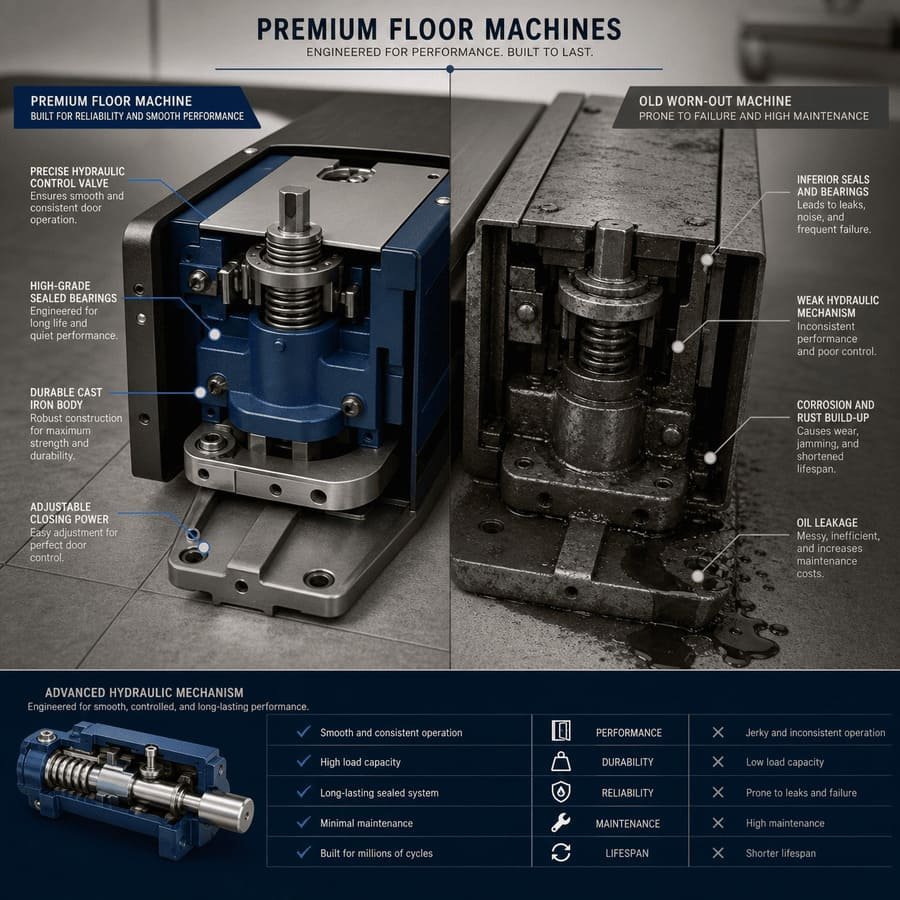
A floor machine works out of sight, buried in the threshold under your glass door, so trouble shows up as a change in how the door behaves rather than as noise from the hardware itself. By the time most owners notice, the unit has been struggling for a while. These are the seven signs we see most often on Dubai glass doors, and what each one points to.
1. The door slams or will not quite pull shut
A floor machine is a hydraulic closer set into the floor: it controls the swing as the door comes down from open, then pushes the last stretch firmly enough for the latch to engage. When the fluid or valves inside the cylinder lose their effect, that control goes and the door gathers speed into the frame. On a heavy glass leaf that impact rattles the patch fittings and stresses the glass edge. The mirror image counts too: a door that stops short and never quite latches.
2. Oil weeping around the floor plate
Check the stainless cover plate in the floor: a dark ring that returns after cleaning, or dust that sticks in patches, is usually hydraulic fluid finding its way past a worn seal. As fluid escapes the level drops, which is why the closing speed often changes at the same time. A seep is worth taking seriously even while the door still works: it stains stone or tile, and a leaking seal rarely heals itself.
3. The door drifts shut or drifts open on its own
If the door creeps closed after you leave it open, or eases away from the closed position, the machine is no longer holding position. On a still day a glass door should stay put. Drift usually comes from fluid bypassing a valve inside the cylinder, or from a floor that has settled slightly and changed the resting angle. Either way the door behaves unpredictably where people prop it open.
4. A squeak, groan or catch at the pivot
A dry squeak where the spindle leaves the floor points at a bearing or bushing running without lubrication. A rhythmic catch you can feel through the glass points the same way: the pivot area is worn or contaminated. Fine dust is the usual culprit in this climate; it works past the plate lip and sits on the moving parts as a grinding paste. Noise rarely travels alone: expect the swing to feel heavier as the wear continues.
5. The patch fitting or the glass above has moved
The floor machine drives the door through a spindle that engages the bottom patch fitting. If that fitting works loose, the door moves a little before the machine does. Viewed from an angle, a shifted fitting shows as a fine gap between metal and glass. Cracks starting at the corner of a patch fitting are serious, because the glass is taking an impact it was never designed to carry. Do not keep forcing the door.
6. An uneven gap between door and frame
Run your eye down the gap between the closed door and the frame; it should be roughly even from top to bottom. A gap that widens at the top and narrows at the bottom usually means the door is sagging, pointing to a worn pivot in the floor machine or a patch fitting loosened above. A gap that is even but tight on one side suggests the floor box sits out of line, or the frame has moved.
7. Sudden stiffness in the swing
You push and the door resists through part of the arc, then releases. Sometimes it sticks in the same spot, sometimes it comes and goes with the temperature. Stiffness usually means contamination or a damaged component inside the cylinder rather than an adjustment that has drifted. A suddenly stiff door is also a safety problem: people put their weight into it, which loads the glass and the fittings above.
What to do when you spot one of these signs
Note what you see and when: closing speed, noise, drift, the gap. That detail makes a visit far more productive. Leave the floor plate alone, and do not force a stiff door. If the glass or a patch fitting shows damage, treat the door as out of service until it has been checked. Power Eagles installs and services floor machines across Dubai — see our floor machine service. Our piece on how a floor machine works explains the parts involved, why Dubai heat and dust shorten floor machine life covers the local conditions, and glass door repair applies when the panel itself has cracked.
Frequently Asked Questions
Can a floor machine be adjusted instead of repaired?
Sometimes. A door whose closing speed has drifted can often be set right at the adjustment screws inside the unit. If fluid is weeping or the door drifts, adjustment will not fix the worn seal or valve behind it.
Is a slamming door always the floor machine’s fault?
Not always. Wind funnelled between buildings, an overhead closer set too weak, or a shifted frame can produce the same symptom. The floor machine is the usual suspect on a frameless glass door, but the cause needs confirming.
How long does a floor machine last in Dubai?
It depends on door weight, traffic and how well the floor box stays clear of dust and water. A quiet office entrance asks far less than a busy shopfront, and a checked unit typically outlasts a forgotten one.
Seeing one of these signs? Call Power Eagles on +971 50 2547177 or message https://wa.me/971502547177 with what the door is doing.
Let's Made Your Custom product !

Our Services
Get In Touch
Copyright © 2026 Power Eagles LLC
- Privacy & policy
- Term & Conditions
Pingback: How a Glass Door Floor Machine Actually Works - PowerEagles LLC - Aluminium & Glass Company
Pingback: Why Dubai Heat and Dust Shorten Floor Machine Life - PowerEagles LLC - Aluminium & Glass Company
Pingback: Repair or Replace: Choosing Honestly When a Floor Machine Fails - PowerEagles LLC - Aluminium & Glass Company