
How a Glass Door Floor Machine Actually Works
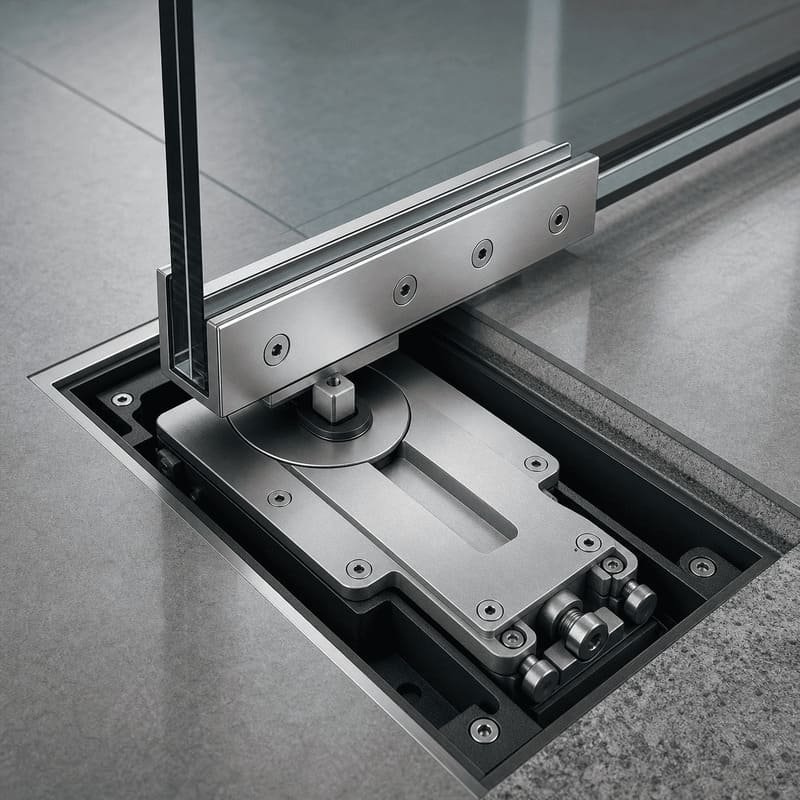
The hardware that controls your glass door is mostly hidden in the floor, which is why people call it a box, a spring or just the hinge when they are looking at it. The trade name is floor machine: a self-contained hydraulic closer set into the threshold. Here is what is actually down there, and how the parts work together every time the door moves.
What sits in the floor box
Under the cover plate there is a cast housing set flush with the finished floor. Inside it sits a cylinder filled with hydraulic fluid, a piston, and the valve circuit that meters the fluid as the piston moves. The assembly is sealed, so none of it is visible while the door is in daily use. The housing carries the door’s weight as well as controlling its movement, which is why the floor box is set into the screed rather than fixed onto the surface. A stainless plate covers the mechanism and keeps dust and cleaning water out.
The spindle and the patch fitting
Rising out of the unit is the spindle, a shaped stub that engages the bottom patch fitting clamped to the glass door. That single connection is how the machine’s effort reaches the door: as the piston works inside the cylinder, torque travels up the spindle and into the fitting. A matching pivot at the top of the opening keeps the leaf aligned. Because the fittings clamp the glass instead of bolting through it, frameless doors keep their clean line. It also means the drive train has to line up, or the door feels loose before the machine has barely started moving.
The hydraulic pulse that controls the swing
Push the door open and let go, and the fluid has to get from one side of the piston to the other. It does so through small passages and adjustable valves, and the resistance those passages create is what slows the door down. Most units work in two stages: a main closing speed that governs the bulk of the swing, and a firmer latching action for the last stretch. Some add a backcheck option that cushions the leaf if it is thrown open hard. The result is the hydraulic pulse tradespeople talk about, meaning steady, damped movement rather than an uncontrolled swing.
The adjustment screws and what they change
Two small screws, usually reachable once the plate is lifted, control those stages. One meters the main closing speed, the other the latching action. Turning them opens or closes the passage the fluid travels through, so the door speeds up or slows down without anything mechanical being replaced. It is a fine setting rather than a repair: if the door still drifts or weeps afterwards, the seals or valves are worn. Working on a unit that is holding a heavy glass leaf needs care and the right tools, so this is normally left to a technician.
Why it is called a floor machine and not a spring
Older concealed units were spring-loaded: a plate set in the floor, a heavy coil and a simple mechanical return. The trade kept calling them floor springs long after hydraulic closers replaced them, and in Dubai the name that stuck for the modern version is floor machine. The distinction matters when you specify hardware. A spring is purely mechanical and its force falls off as it ages, while a hydraulic closer controls speed through fluid, which is why the closing action stays even across the temperatures the door sees. Overhead closers do the same job above the door, with an arm that would interrupt a frameless glass front.
What this means when something goes wrong
Nearly every symptom you see at the door traces back to one of these parts: fluid and valves behind the closing speed, the spindle and patch fitting behind looseness, the pivot behind noise. That is why the first job is diagnosis rather than swapping parts. If the door’s behaviour has changed, read the seven warning signs and write down what it does. Our guide to repair or replacing a failed floor machine covers the decision that follows, floor machine brands in Dubai explains the names you will be quoted, and for office and retail entrances see commercial glass door repair. Power Eagles installs and services these units, and handles glass door floor machine replacement in Dubai — details on our floor machine service page.
Frequently Asked Questions
Is a floor machine the same as a door closer?
They do the same job by different routes. An overhead closer is mounted above the door with an arm, while a floor machine is concealed in the threshold. On frameless glass doors the overhead type would interrupt the clean line, so the concealed unit is the usual choice.
Does the floor machine carry the weight of the glass door?
Yes. The lower pivot built into the unit supports the leaf, and the hydraulic circuit controls how it moves rather than holding the weight. That load is one reason the unit has to be matched to the door rather than picked off a shelf.
Can I adjust a floor machine myself?
The screws are accessible once the plate is lifted, but the unit sits under a heavy glass leaf and the settings are sensitive. Small turns change the door’s behaviour noticeably. Unless you know the sequence, this is work for a technician.
Want the unit under your door explained or checked? Power Eagles is on +971 50 2547177, or message https://wa.me/971502547177.
Related glass door guides
A floor machine is only part of the door; our glass door repair service in Dubai covers the panel, fittings and closer as one system. You may also find how Dubai heat and dust shorten floor machine life and what to do when a glass door won’t close properly useful.
Let's Made Your Custom product !

Our Services
Get In Touch
Copyright © 2026 Power Eagles LLC
- Privacy & policy
- Term & Conditions
Pingback: 7 Warning Signs Your Glass Door Floor Machine Is Failing - PowerEagles LLC - Aluminium & Glass Company
Pingback: Floor Machine Brands in Dubai: GEZE, dormakaba, ASSA ABLOY and OLEFINI Explained - PowerEagles LLC - Aluminium & Glass Company