
Patch fittings and patch locks: the hidden hardware in frameless glass doors
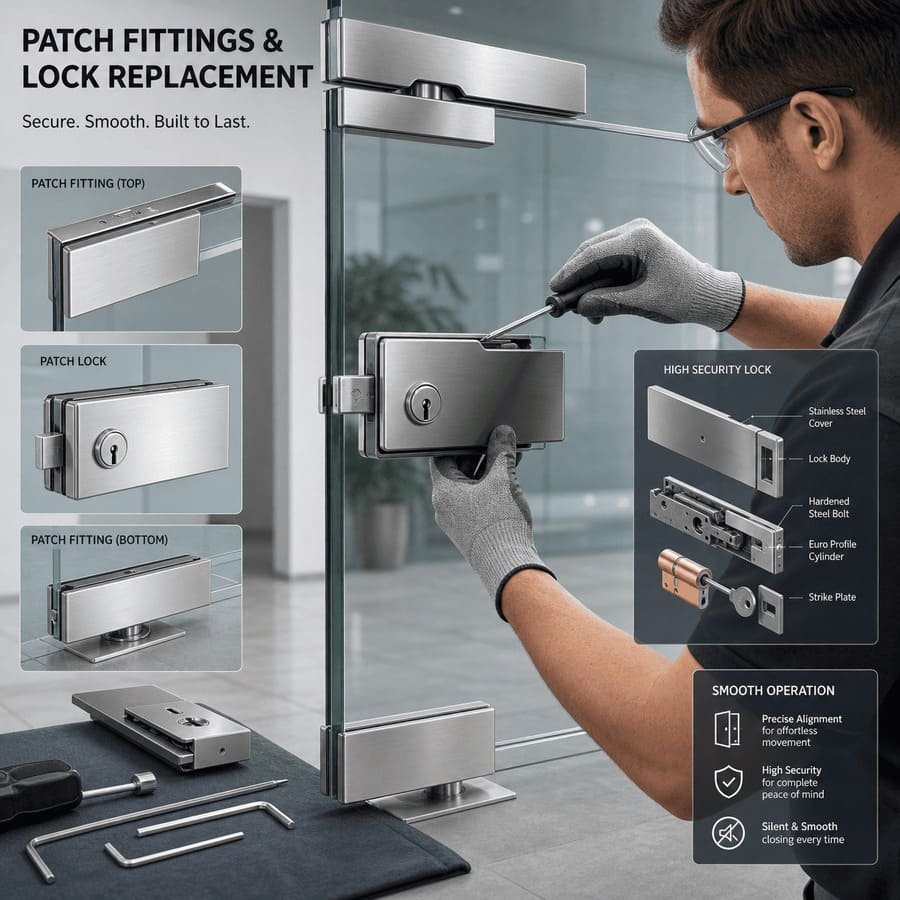
A frameless door carries its full weight through a handful of stainless boxes clamped to the glass. Those are patch fittings, and the lock or handle bolted into one of them is a patch lock. Nobody thinks about this hardware until the door sags, rattles, or the key stops turning — and by then the fitting is telling you something specific.
What each fitting actually does
A frameless door skips the frame by grabbing the glass itself:
- Top patch: carries the pivot; a pin or drop stay locates into it so the panel swings.
- Bottom patch: sits over the floor machine box and connects the panel to the closer spindle.
- Lock patch: a housing at the closing edge, built around a cutout in the glass, holding the lock body and bolt.
- Handle patch: the fixing point for pull handles and panic hardware.
Each one grips the glass through gaskets with screws behind them. The glass was cut and drilled before tempering, so every hole and cutout in your door is permanent — and that one fact decides most repair-versus-replace calls.
Where they fail
Failures run in patterns. Water and cleaning chemicals collect at floor level and attack the bottom patch and its fixings first. Clamp screws creep loose as gaskets harden under daily vibration. Top pivot sockets wear around the pin, and the play gets felt as a door that is loose in the hand. Patch locks wear mechanically — cams, spindles, sticking cylinders — but a lock that suddenly refuses to line up with its strike is usually a sagging panel, not a failed lock. Diagnose in that order: check what holds the door before you blame what locks it. The same logic runs through glass door won’t close properly.
Loose fittings: what proper tightening means
A loose patch is never one screw. Correct tightening means supporting the panel, slackening the clamp screws together, resetting height and edge gap, placing fresh packing under the glass, then bringing the screws up evenly, a little at a time. A single screw torqued into a dry clamp puts point load straight into hardened glass — exactly where a crack starts on a hot day. Over-tightening crushes the gasket past its working range, so the joint goes slack again sooner. If a fitting takes up cleanly and holds, the job is done. If it slackens again, the gasket, the fixing plugs in the floor, or the cutout itself has failed, and that is when a glass door repair in Dubai should address panel, fitting and floor box as one piece of work.
Replacement logic — and the tempering constraint
Worn parts get replaced like for like: pins, sockets, gaskets, screws, lock bodies, handles. What cannot be done is moving a patch. Tempered glass cannot be re-cut or re-drilled; drilling a toughened panel shatters it, so new hole positions mean a new panel. When cutouts are chipped, cracked or worn oval, or a replacement fitting does not match the old geometry, the hardware decision is really a glass decision — the reasoning is set out in cracked glass door panel: repair or replace?. Panel and fittings should also be inspected together whenever the closer is renewed, because the bottom patch interfaces directly with the floor machine.
The safety side
A frameless panel that loses its top patch or pivot is a falling hazard, not a nuisance. If the panel lifts off its pivot or leans out of plumb under hand pressure, take the door out of service — restrain it or remove it — until it is properly secured. Do not shim a loose patch with whatever is in the toolbox; wedges and extra washers change how the panel bears and hide the fault instead of fixing it. Do not hang weight on a handle whose patch has gone soft. Inspect the fittings after any knock that leaves the door looking straight but feeling wrong. If the slack door also resists or rubs the frame, the closing fault has its own logic — glass door won’t close properly.
Frequently Asked Questions
Do patch fittings have to match the glass thickness?
Yes. Patches clamp a specific panel thickness — typically 10 or 12 mm door glass — and mixing gasket stacks or thicknesses changes both grip and alignment. Replacement fittings are specified to the panel, not just matched to look the same.
The key in my patch lock turns, but the bolt doesn’t throw.
Most often the panel has dropped so the bolt no longer enters the strike, or the cam inside the fitting has worn. Check the holding hardware before replacing the lock: a new lock on a sagging door jams exactly like the old one.
A fitting hole in the glass is chipped. Can it be filled?
No. Toughened glass takes no structural repair, and edge damage around a cutout grows. The panel gets replaced.
Power Eagles supplies, tightens and replaces patch fittings and patch locks on frameless glass doors across Dubai. Talk it through with a technician on +971 50 2547177, or send a photo of the fitting through WhatsApp so the hardware can be identified before anything is ordered.
Let's Made Your Custom product !

Our Services
Get In Touch
Copyright © 2026 Power Eagles LLC
- Privacy & policy
- Term & Conditions