
Soundproofing sliding doors: the weak points and what actually helps
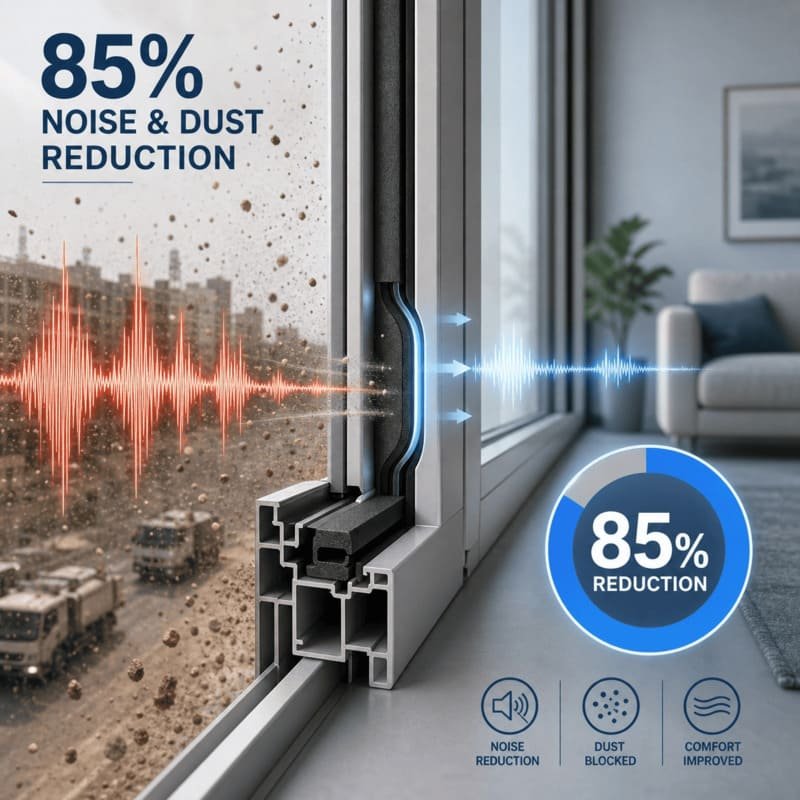
Sliding doors are the hardest opening to quieten. A casement window compresses a gasket shut; a sliding door glides over a brush seal and needs clearance to move. That clearance is where sound gets through, and it is why a sliding door often lets in more noise than a window of the same size.
Why sliding doors leak
The panel has to slide, which means it cannot be pressed hard against a seal. The meeting stile where two panels overlap uses a brush or fin seal rather than compression. The top and bottom tracks need roller clearance.
Every one of those is a path for sound, and together they add up. This is also why a sliding door can feel draughty on a windy evening even when the glass is fine.
The weak points, one by one
Work down the door and check each of these:
- The meeting stile between panels.
- The top track, where the panel is guided.
- The bottom track and its drainage gap.
- The frame-to-wall joint at the head and jambs.
- The glass itself, if it is thin or single-paned.
Write down what you find. Two of those five are usually doing most of the work, and the order tells you where to start.
Brush seals versus compression seals
A brush seal is a strip of bristles that closes a gap loosely; a compression seal is a rubber gasket that is squeezed shut. Brush seals tolerate sliding and dirt, but they do not seal tightly.
Where a part of the door can take a compression seal, for example a fixed panel or an added inner door, the seal is more effective. On the moving panel, brush seals are often the practical choice, and fresh bristles in good condition beat worn, flattened ones every time.
Roller gaps
Rollers need clearance to roll. Worn rollers or a sagging panel increase that clearance and open up the top and bottom gaps. Adjusting or replacing the rollers can bring the panel back to a tighter fit.
It is a small job that often makes a noticeable difference, and it is worth doing before anything more involved. A panel sitting at the wrong height also drags, which wears both the track and the seal.
Glass: laminated versus toughened
Glass type matters. Laminated glass has a plastic interlayer that damps vibration, so it resists sound differently from toughened glass of the same thickness. Toughened glass is about strength and safety; laminated glass is about how it behaves under sound and impact.
On a noisy road, laminated panels are worth considering. If the door is being replaced anyway, this is the moment to choose the glass rather than fit the same unit again.
What helps most, in order
Work from the top of this list down and you get the most improvement for the least disruption:
- Seal the frame-to-wall joints.
- Renew worn brush seals.
- Adjust or replace rollers to reduce clearance.
- Add an inner barrier or a secondary door where possible.
- Consider thicker laminated glass or a new door.
The first three are usually a single visit. The last two are projects, and they make more sense once the less costly fixes are done and you know what is left.
Realistic expectations
You will reduce what comes through, and on a noisy road the change can be noticeable. You will not make a sliding door behave like a sealed wall, and anyone promising otherwise is overselling.
Sliding door repair and maintenance and glass door repair address most of the weak points listed here, while our window and door soundproofing service handles the assessment and the glazing side together. For the room-level view, see our guide to soundproofing an apartment against city noise, and read the truth about soundproof windows before you buy anything.
Frequently Asked Questions
Can a sliding door ever be as quiet as a fixed window?
Not fully, because it has to slide and therefore needs clearance. You can reduce what comes through significantly, but the moving seal will never match a compressed one.
Do I need to replace the whole door?
Often not. Sealing the frame, renewing brush seals and adjusting rollers address the main leaks first. Replacement is the last step, not the first.
Are brush seals good enough?
They do a job while they are in good condition, but they seal loosely by design. Worn bristles leak, so renewing them is one of the most useful improvements available.
Is laminated glass worth it for noise?
Laminated glass behaves better under sound than toughened glass of the same thickness because of its interlayer, so it is worth considering on a noisy road.
Sliding door letting the street in? Send a photo of the meeting stile and tracks on WhatsApp at wa.me/971502547177, or call +971 50 2547177, and we will tell you what will help most.
Let's Made Your Custom product !

Our Services
Get In Touch
Copyright © 2026 Power Eagles LLC
- Privacy & policy
- Term & Conditions