
A Sliding Door Fitted Badly: The Faults That Only Show Up Later
Dubai threads on home maintenance return to the same theme again and again: getting someone who does the job properly the first time. Residents describe a three-metre sliding opening that was installed so badly they can feel air and hear traffic through it, contractors who charged and left a mess, and having to work through several companies before finding one that finished. Sliding doors are where this shows up most, because an installation can look perfect on the day and fail quietly for months.
Why a bad install hides at first
A new sliding door that opens and closes will feel acceptable in the first week. The problems are not about whether it moves – they are about how the frame and track were prepared, whether the opening was squared, and what was packed behind the frame. Those show up later as draughts, water where it should not be, doors that stop latching, and rollers that fail long before they should.
The frame was never squared or packed
A sliding frame has to be set plumb, level and square, then packed at the correct points so it cannot move. Skip that and the panels do not meet evenly, the frame twists over time, and every seal works against a gap that was never going to close. This is the most common cause of a door that still lets in air, noise and dust after it has been replaced once.
The track and sill were set wrong
- No fall or the wrong fall at the sill, so water sits on the track instead of draining out
- Track height set so the brush pile barely touches, leaving the bottom of the opening open
- Drainage slots blocked or drilled in the wrong place during fitting
- No allowance for the amount of sand and grit the door will collect, so the track silts up within a season
The result is a door that is hard to close against the seal, or one that holds water against the frame.
Hardware chosen to a price
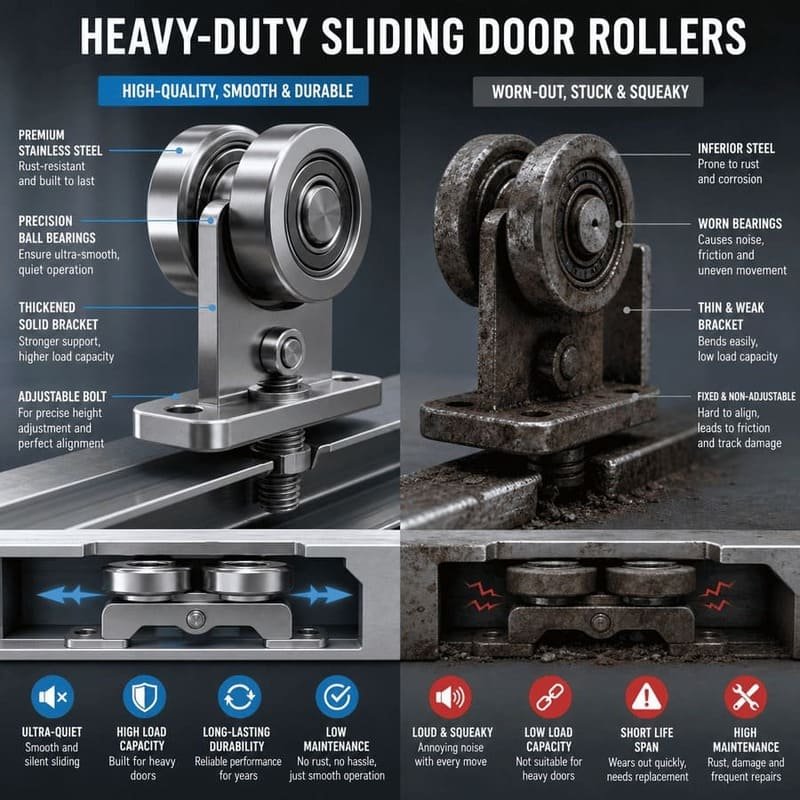
Rollers, locks, strikers and brush seals are where a cheap installation saves its money, and they are invisible once the door is hung. Rollers sized below the panel weight flatten early, locks are fitted without the striker being aligned to the frame, and brush seals are left as the wrong depth for the gap. Each costs far more to correct later, because the door has to come out to change it. Our guide to rollers and worn tracks covers how to test which part has failed, and the installation-fault checklist in our five-reasons article covers what makes a hung door hard to move.
What to check before you accept the work
- Push the closed door against the frame – can you feel air moving at the meeting stiles, the bottom rail or the head?
- Look at the gap between the frame and the wall along its whole height – is it even, with no gaps in the sealant line?
- Open and close the door through its full travel – does it run without a grinding or catching point?
- Check both leaves shut flush, and that the lock lines up without lifting or forcing
- Look at the sill – does it shed water, or hold it?
- Ask what was packed behind the frame and confirm the fixings, while the fitter is still on site with the opening accessible
Photograph the meeting stiles and the sill before anything is cleaned up.
What can still be put right
Plenty of badly fitted doors can be recovered without replacing them. Re-packing and re-sealing the frame, re-setting the track and sill, changing worn or undersized rollers, and aligning the lock all fix faults that were caused at installation. What is usually not recoverable is a frame fitted so far out of square that the panels will never meet properly. If the door is also letting in hot air at the balcony, that is covered in our balcony door leak guide, and the service page covers what a correction involves.
Frequently Asked Questions
The door is new, so why is it already hard to close?
Newness does not mean a good fit. A door that is difficult within its first weeks usually points to the track height, a frame that is not square, or a roller sitting below the panel weight. All three are installation faults rather than wear.
Should the installer be asked to come back?
Yes, while the work is recent. Photograph what you can show and be specific – where the air comes in, which leaf is out of line, where it catches – and ask for the frame and track to be checked rather than the symptom adjusted away.
Can a badly fitted frame be fixed without replacing the door?
Often, yes: re-packing and re-sealing the frame, correcting the track and sill, and changing rollers or locks recovers a door that was simply fitted in a hurry. A frame that was fitted well out of square is the case that usually cannot be saved.
Door fitted badly, or moving on to a repair after one? Call Power Eagles on +971 50 2547177 or message https://wa.me/971502547177 with photos of the frame, track and sill.
Let's Made Your Custom product !

Our Services
Get In Touch
Copyright © 2026 Power Eagles LLC
- Privacy & policy
- Term & Conditions