
Sliding Door Lock and Handle Replacement Guide
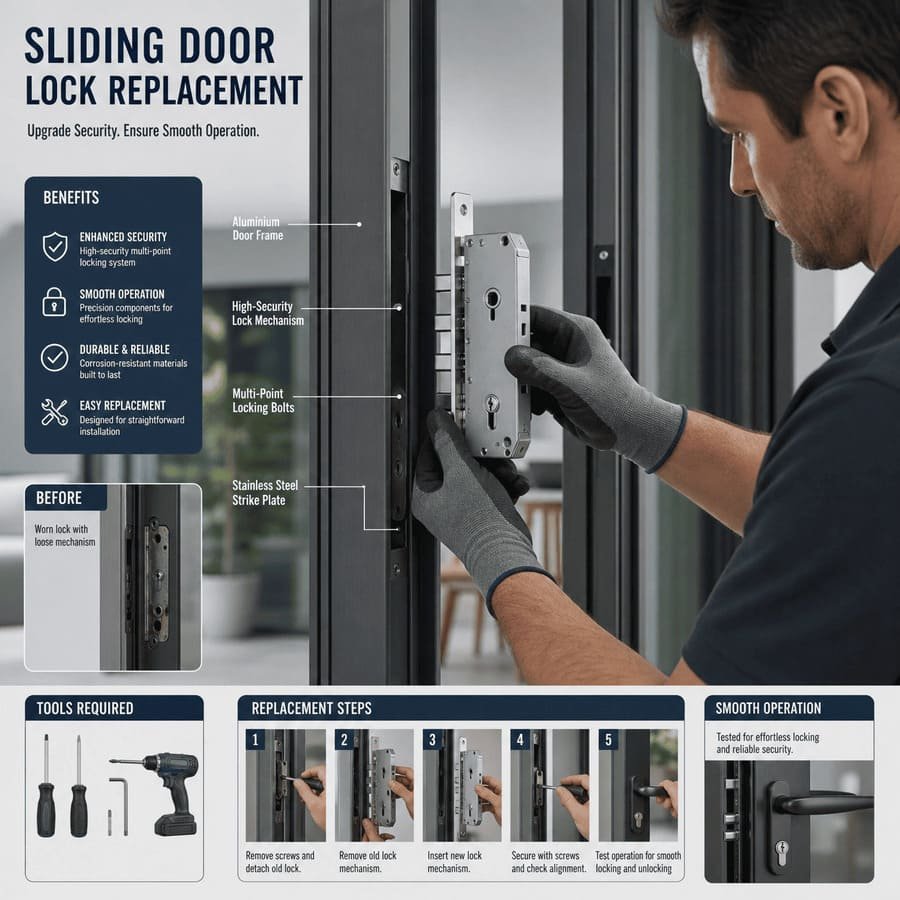
A lock that will not throw feels like a lock problem. Half the time it is not — it is the door. Before buying hardware, it pays to know which failures come from the fitting and which come from the sash hanging where it should not.
The common failures
On sliders, handles snap at the screw line where years of pulling transfer into plastic or thin alloy. Lock cylinders jam when scale and dust work into the keyway, or the cam wears until the tongue moves without engaging anything.
Multi-point locking strips go out of adjustment: the top and bottom hooks no longer throw in sequence with the central latch, so the door feels locked only if you lift the sash first. Patio and shopfront units share mechanisms but not duty cycles — a shopfront slider is cycled far harder, and its hardware reflects that.
Why misalignment breaks locks
This is the point most owners miss. A door whose rollers have collapsed or whose frame has shifted no longer sits square to its keep, so the lock tongue lands off-centre, drags on the strike, and forces with every turn of the key. That force travels through the cam and cylinder until something wears or snaps.
Replace the lock alone and it fails again the same way. Check the door’s ride first — a drop in the sash explains a surprising share of lock complaints, and our sliding door hard-to-open guide walks the likely causes. Fix the alignment, then the hardware has a fair life.
Choosing replacements
- Lock cylinders: match the backset and key profile; keyed-alike sets are useful when patio and side doors should share one key.
- Multipoint strips: must match the existing groove profile and hook positions — these are rarely universal, so bring the old strip or its measurements.
- Handles and pulls: choose material for duty. Exterior patio hardware wants corrosion-resistant stainless or coated alloy; indoor pull handles tolerate lighter grades.
- Shopfront sliders: specify commercial-grade mechanisms. Domestic hardware simply does not survive a busy counter, and changing it twice costs more than doing it once.
Bring the door’s make, a photograph of the faceplate and the sash thickness to a supplier, or have us match it — pattern mismatch is the usual reason a ‘universal’ part sits in a drawer.
The job itself
Replacement is straightforward once the sash is accessible: remove the handle halves, extract the lock body or strip, fit the new part with its keep adjusted, then test the throw with the door both open and closed before final tightening.
The keep adjustment is the step shortcuts skip. Test the engagement while the door is shut under its own weight, not slid open on the floor — doors behave differently loaded. While the sash is out, it is the natural moment to check rollers, track and bottom seals in one pass; if the track is already rough, see telling rollers from a worn track.
Patio versus shopfront considerations
A patio slider is about weather sealing, home security and a key you can trust — multipoint hooks into the head and sill suit that. A shopfront slider needs tamper resistance, cycle life, and often a latch compatible with a shutter or a customer-flow pattern; panic hardware and heavy-duty strikes are the usual answers.
Both benefit from the same advice: replace like for like where the door is sound, and treat a repeated lock failure as a symptom of the sash sitting wrong. Where hardware, alignment and glass all need attention together, our sliding door repair service in Dubai handles it as one job with one written quote.
Frequently Asked Questions
Can I just replace the lock cylinder?
If the cylinder is the only worn part and the mechanism it drives is sound, yes — it is a small job. If the tongue or hooks already move sloppily, changing only the cylinder leaves the fault in the mechanism, and the key keeps lying to you.
Why does my door only lock when I lift it?
Because the sash sits low on worn rollers, dropping the lock out of line with its keep. Lifting restores the alignment temporarily. The durable fix is rollers and adjustment, not a new lock.
My key turns but the door is not secure — what is that?
Usually a worn cam or a stripped multipoint strip where the hooks no longer engage their keeps. Have the mechanism tested with the door closed and loaded; a lock that only appears to throw is worse than one that will not.
Power Eagles supplies and fits sliding door locks, handles and multipoint mechanisms across Dubai, patio and shopfront alike. Call +971 50 2547177 or message us on WhatsApp (https://wa.me/971502547177) and we will match the hardware to your existing door.
Let's Made Your Custom product !

Our Services
Get In Touch
Copyright © 2026 Power Eagles LLC
- Privacy & policy
- Term & Conditions